
Jun 26, 2026 · ApiAny Team
OpenAI's Last Stand: GPT-5.6 Is Coming, and the AI Industry Landscape Is About to Shift
GPT 5.6 is expected to launch on June 26, 2026, featuring a 1.5-million-token ultra-long context, zero-shot UI generation, GPT Bidi 1 true bidirectional voice, and project-level Agentic programming, with API pricing just one-third that of Claude Fable 5; this article traces its codename leak, benchmark comparisons with rivals, and OpenAI's market maneuvering as its share falls below 50%, its valuation is overtaken by Anthropic, and it pushes toward a trillion-dollar IPO.
I. The Mystery of the Codenames: From iris-alpha to kindle-alpha
——One model, four name changes, five rounds of leaks—GPT-5.6 walked the final stretch toward release through a labyrinth of codenames.
GPT-5.6's first exposure did not come from an official OpenAI announcement, but from an accidental code leak. On May 13, 2026, AI community researcher Haider, while routinely analyzing OpenAI Codex backend routing logs, discovered an entry named gpt-5.6. This entry survived in the logs for less than 24 hours before being cleared, but sharp-eyed researchers screenshotted, archived, and cross-verified it, igniting discussion across the entire AI community.
In the following weeks, developers gradually discovered multiple associated codenames through different channels. The earliest to appear in the Codex logs was iris-alpha , speculated to be an internal training version with a context window of about 1.5 million tokens. After that, two new checkpoint codenames, kindle and kepler , were also leaked one after another. According to multiple reliable sources, kindle-alpha has been officially selected as the Release Candidate for GPT-5.6.
|
|
|
|
|
|---|---|---|---|
|
|
|
|
|
|
|
|
|
|
|
|
|
|
|
|
|
|
|
|
|
|
|
|
|
▲ Table: GPT-5.6 Codename Evolution Timeline
The reasoning behind the release timing was equally full of twists and turns. According to data from the Polymarket prediction market, the betting probability for "GPT-5.6 releasing between June 22 and 28" has surged to 78%. Meanwhile, several tech media outlets cited internal sources stating that June 26 (this Thursday) is the most likely debut date for GPT-5.6 . OpenAI Chief Scientist Jakub Pachocki confirmed to internal employees on June 11 that GPT-5.6 is "on its way," and described it as a "meaningful leap" over GPT-5.5.
II. Core Technical Breakthroughs: More Than Just "Bigger"
——A 1.5-million-token context, zero-shot UI generation, true bidirectional voice, and Agentic programming—four leaps that attempt to redefine "what AI can do."
1. 1.5-Million-Token Ultra-Long Context——Redefining "Done in One Go"
The most striking technical upgrade in GPT-5.6 is undoubtedly the rumored 1.5-million-token context window . Compared to GPT-5.5's 1 million tokens, this represents a 50% increase; and compared to rival Claude Fable 5's 500,000 tokens, it is a full three times larger. Developers and enterprise users can feed complete codebases of hundreds of thousands of lines, or financial audit reports spanning hundreds of pages, into the model for processing all at once.
2. Frontend/UI Generation——Zero-Shot Commercial-Grade Interface Output
If expanding the context window is "quantitative change," then GPT-5.6's breakthrough in frontend development is a jaw-dropping "qualitative change." Give the model a reference image, and it can instantly generate a pixel-perfect UI replica——it can even "seamlessly fill in and restore" parts of the original image that were redacted or covered by grid lines, based on its own knowledge reserves. After hands-on testing, developer Pankaj Kumar reported that GPT-5.6 Pro can replicate nearly every design element in a reference image——from color schemes, font hierarchy, and spacing rhythm to interaction logic.
3. GPT-Bidi-1: Ending "Walkie-Talkie-Style" AI, Entering the Era of True Bidirectional Conversation
Exposed alongside GPT-5.6 Pro is the mysterious project GPT-Bidi-1 . Since the release of GPT-4o, voice AI has remained stuck in the "walkie-talkie" paradigm——you must finish speaking, stop, and wait before the AI can respond. GPT-Bidi-1 completely shatters this wall: achieving truly resonant, real human-machine dialogue——listening and speaking simultaneously, responding in real time . If you suddenly interrupt while it is talking, it can instantly absorb your interruption mid-sentence and naturally adjust its subsequent response logic.
4. Agentic Programming Workflow——From "Writing Code" to "Doing Projects"
In GPT-5.6's strategic layout this time, the direction that truly points to the future is the Agentic workflow . AI no longer merely answers individual programming questions, but acts as an autonomous agent to fully plan and execute an entire software engineering task——from understanding requirements, designing solutions, writing code, running tests, and fixing bugs, to final code review and documentation generation. On the authoritative SWE-bench Verified benchmark, GPT-5.6 scored 68.5%, significantly higher than Mythos's 62.3%.
|
|
|
|
|
|
|---|---|---|---|---|
|
|
|
|
|
|
|
|
|
|
|
|
|
|
|
|
|
|
|
|
|
|
|
|
▲ Table: Core Technical Capability Comparison of the Big Three's Flagship Models
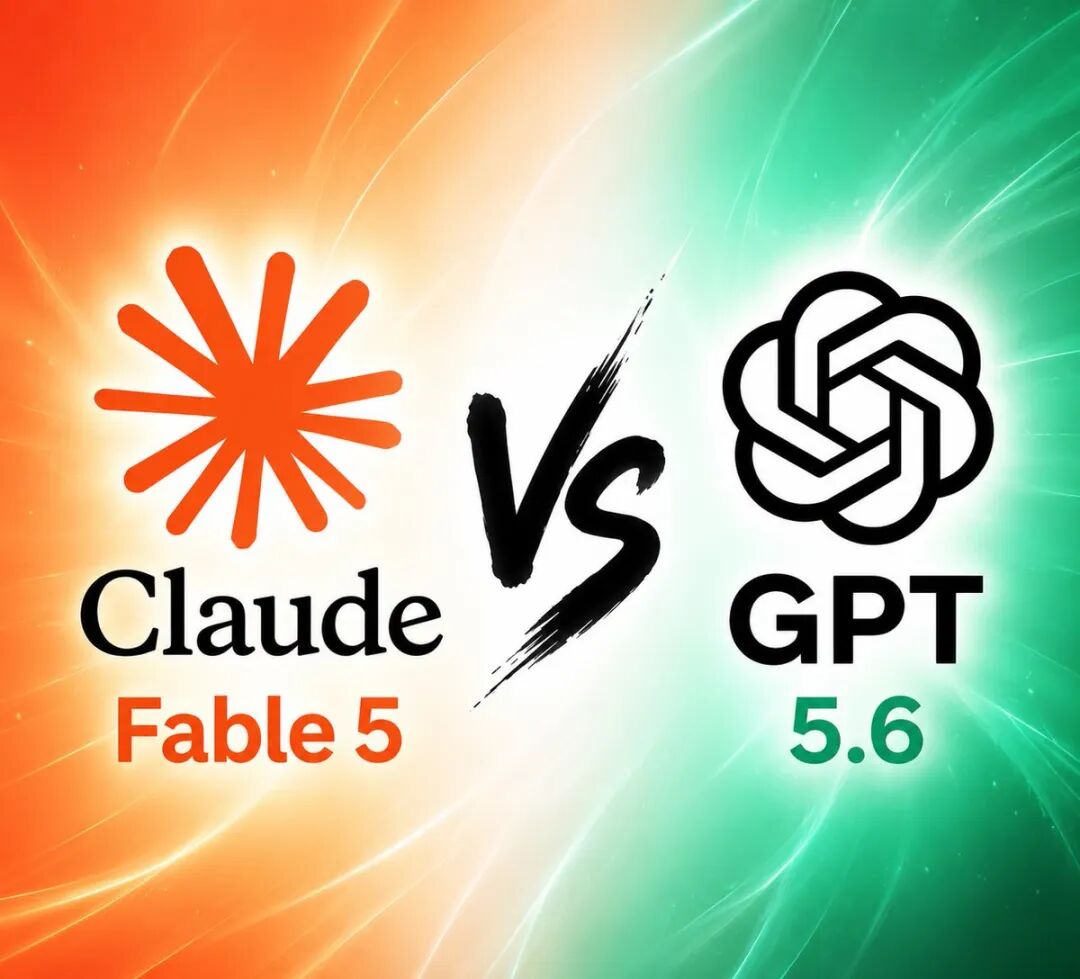
III. Hands-On Showdown: GPT-5.6 vs Claude Fable 5
——SWE-bench jumped from 58.6% to 68.5%, but Fable 5's 80.3% still stands as a high, hard threshold.
After Anthropic released Claude Fable 5 on June 9, the landscape of the AI capability leaderboard was completely rewritten. Fable 5 scored 80.3% on SWE-bench Pro, while GPT-5.5 only reached 58.6%—a gap of as much as 22 percentage points. In the Artificial Analysis Composite Intelligence Index, Fable 5 ranked first among all models with 64.9 points, while GPT-5.5 placed third with 60.2 points—across 10 individual benchmarks, Fable 5 took 5 first-place finishes.
|
|
|
|
|
|
|---|---|---|---|---|
|
|
|
|
|
|
|
|
|
|
|
|
|
|
|
|
|
|
|
|
|
|
|
|
▲ Table: Data comparison between GPT-5.6 and major competitors on core benchmarks
A more subtle game is unfolding: Fable 5 has already shown its hand across the various leaderboards, while OpenAI can still, before the official release, conduct one final round of targeted refinement and parameter tuning based on its rivals' scores.
IV. Pricing Revolution: Striking First in the Price War
——With API pricing at only one-third of its rival's, and despite losing $14 billion a year, it still chooses to cut prices first—a high-stakes gamble trading profit for market share.
What has shaken the industry even more than the technical specs is just how aggressive GPT-5.6 is in its pricing strategy. According to multiple reliable sources, GPT-5.6's API pricing is only one-third that of Claude Fable 5 . Fable 5's current pricing stands at $10 per million input tokens and $50 per million output tokens—roughly twice that of Opus. GPT-5.6's pricing strategy is tantamount to launching a lightning price war during the rival's most vulnerable time window.
|
|
|
|
|
|---|---|---|---|
|
|
|
|
|
|
|
|
|
|
|
|
|
|
|
|
|
|
|
|
▲ Table: API Pricing Comparison of Flagship Models
However, behind this pricing strategy lies a massive financial gamble. OpenAI burned through a staggering $34 billion in fiscal year 2025—including $19 billion in R&D investment and $6 billion in marketing—while annual revenue was estimated at only $13 billion, resulting in a loss of about $14 billion. Altman's calculation: at a moment when Anthropic, valued at $965 billion, surpassed OpenAI ($852 billion) for the first time to claim the industry's top spot, grabbing market share first and worrying about profits later may be the only path to survival.
V. Market Landscape: A Last Stand Under the Trillion-Dollar IPO Gamble
—ChatGPT's share falling below 50%, Anthropic's valuation overtaking it, and the money-burning black hole of a 10GW data center—three pressures bearing down simultaneously.
On June 8, 2026, OpenAI confidentially filed for an IPO with the U.S. Securities and Exchange Commission (SEC), jointly underwritten by Goldman Sachs and Morgan Stanley, with the listing window set between September and November. In the same month, its long-time rival Anthropic also submitted its S-1 filing. The fact that two AI giants made their bids for the public markets one after another within the same month is itself an epochal milestone.
|
|
|
|
|---|---|---|
|
|
|
|
|
|
|
|
|
|
|
|
|
|
|
|
|
|
|
|
▲ Table: Comparison of Key Financial and Competitive Metrics for OpenAI vs Anthropic
According to the latest data disclosed by TechCrunch in June 2026, ChatGPT's market share dropped below 50% for the first time, currently stuck on the life-or-death line of 46.4% . GPT-5.6—from the ultra-long context of 1.5 million tokens to the genuine bidirectional dialogue of GPT-Bidi-1, from the dimensionality-reducing strike on front-end UI to the engineering breakthroughs in Agentic programming—is precisely the decisive trump card Altman is using to stabilize investor confidence and reclaim market dominance.
VI. Conclusion: This Is Not Just the Release of a Model
——As AI accelerates from "quarterly iterations" to the "weekly update era," the outcome of GPT-5.6 is not only about technology, but also determines whether OpenAI can hold onto its qualification for a trillion-dollar IPO.
In June 2026, we are witnessing the AI industry enter an entirely new rhythm—no longer quarterly updates, no longer half-yearly iterations, but a true "weekly update era." Claude Fable 5 swept the rankings on June 9, GPT-5.6 is expected to strike back forcefully on June 26, and Gemini 3.5 Pro is poised to make its move with a 2 million token context.
The story of GPT-5.6 goes far beyond an ordinary version iteration. It is OpenAI's all-out struggle on the life-or-death line where its market share has fallen below 50%, the most important chip in a trillion-dollar IPO gamble, and an epitome of the entire AI industry's arduous transition from "burning money for scale" to "trading efficiency for sustainability." From GPT-5.6 Pro replicating famous paintings out of thin air, to GPT-Bidi-1 achieving true bidirectional communication, to defeating Mythos head-on in Agentic programming benchmarks—OpenAI is telling the world through brute-force aesthetics and engineering innovation: we still have cards up our sleeve.
This Thursday, if the rumors prove true, we will together witness a brand-new leap in large model capabilities. And in this "speed and passion" performed by the AI Big Three in the midsummer of 2026, the ultimate decider of victory may lie not in who runs faster, but in who can run farther.
Sources
Which official references does this page cite?
The quotations below are from official API documentation that APIAny implements against.
The Chat Completions API endpoint will generate a model response from a list of messages comprising a conversation.
The Gemini API provides access to Google's most capable generative AI models.