

Text Generation

Anthropic logoAnthropic

Claude Opus 4.8 API

Anthropic Claude Opus 4.8 is a frontier model for demanding reasoning, large codebases, long-form analysis, and complex agent workflows.

24H Status Monitor
24h success rate: 100%
Claude Opus 4.8

Model:

claude-opus-4-8
Price: 5 credits per 1K input tokens · ≈ $0.0025-$0.005 · 24 credits per 1K output tokens · ≈ $0.012-$0.024High stability with detailed usage records on the APIAny platform.
PlaygroundHistoryPricingModel overviewUse casesAPIFAQ
claude-opus-4-8
62 (suggested: 2,000)
0.7
02

Sampling temperature. Lower is more deterministic.

1024
168192

Optional reasoning effort. Leave unset to use the model default. Higher effort can use more tokens and time.

->

USD estimate $0.0125-$0.025: highest recharge package uses $1 = 2,000 credits; entry package uses $1 = 1,000 credits.

Preview
No Task Running
Claude Opus 4.8
LLMResult preview

History

Saved locally in this browser

0 running · 0 completed

Your generation history will appear here

Input

5 credits/1K

≈ $0.0025-$0.005

Output

24 credits/1K

≈ $0.012-$0.024

Cache

0.5 credits/1K

≈ $0.0003-$0.0005

Context

-

Max output

-
View API usage
Pricing
Model ID
Type
Quality
Price
claude-opus-4-8
Text Generation
Input tokens
5 credits per 1K input tokens · ≈ $0.0025-$0.005
claude-opus-4-8
Text Generation
Cache read tokens
0.5 credits per 1K cached input tokens · ≈ $0.0003-$0.0005
claude-opus-4-8
Text Generation
Output tokens
24 credits per 1K output tokens · ≈ $0.012-$0.024
claude-opus-4-8
Text Generation
Minimum request
0.24 credits minimum · ≈ $0.0001-$0.0002
Model IDclaude-opus-4-8
TypeText Generation
QualityInput tokens
Price5 credits per 1K input tokens · ≈ $0.0025-$0.005
Model IDclaude-opus-4-8
TypeText Generation
QualityCache read tokens
Price0.5 credits per 1K cached input tokens · ≈ $0.0003-$0.0005
Model IDclaude-opus-4-8
TypeText Generation
QualityOutput tokens
Price24 credits per 1K output tokens · ≈ $0.012-$0.024
Model IDclaude-opus-4-8
TypeText Generation
QualityMinimum request
Price0.24 credits minimum · ≈ $0.0001-$0.0002

API Reference

Call this model through a standard REST API. Authenticate with your API key, then pick an endpoint below to see its parameters and examples.

Authentication

Every request needs a Bearer token in the Authorization header. Create an API key in the console.

Authorization: Bearer YOUR_API_KEY
POSThttps://apiany.ai/v1/chat/completions

Request parameters

ParameterTypeRequiredNotes
modelstringRequiredModel identifier to invoke. Use this model's ID.
messagesarrayRequiredConversation history in OpenAI chat format (role + content).
streambooleanOptionalWhen true, the response streams back as server-sent events.

Request example

curl "https://apiany.ai/v1/chat/completions" \
  -H "Authorization: Bearer YOUR_API_KEY" \
  -H "Content-Type: application/json" \
  -d '{
  "model": "claude-opus-4-8",
  "messages": [
    {
      "role": "user",
      "content": "Summarize the following text in three concise bullet points:"
    }
  ],
  "temperature": 0.7,
  "max_tokens": 1024
}'

Response example

{
  "id": "chatcmpl-abc123",
  "object": "chat.completion",
  "model": "claude-opus-4-8",
  "choices": [
    {
      "index": 0,
      "message": {
        "role": "assistant",
        "content": "Hello! How can I help?"
      },
      "finish_reason": "stop"
    }
  ],
  "usage": {
    "prompt_tokens": 12,
    "completion_tokens": 18,
    "total_tokens": 30
  }
}

More models

Explore all models

GLM-5.2

GLM logoText Generation

Gemini 3.5 Flash

Google logoText Generation

MiniMax M3

MiniMax logoText Generation

DeepSeek V4

DeepSeek logoText Generation

Model overview

What is the Claude Opus 4.8 API?

Anthropic Claude Opus 4.8 is a frontier model for demanding reasoning, large codebases, long-form analysis, and complex agent workflows.

Evaluate the model against reasoning depth, workflow fit, and production constraints before standardizing a route.

Claude Opus 4.8 is available on APIAny as one documented API surface with live pricing, model status, request examples, and an on-page playground. Teams can evaluate the model here, then keep authentication, usage records, and production routing in the same platform.

Try Claude Opus 4.8 in the playground
Claude Opus 4.8 API workflow overview on APIAny
A visual map of the Claude Opus 4.8 workflow.

Sources

Which official references does this page cite?

The quotations below are from official API documentation that APIAny implements against.

Send a structured list of input messages with text and/or image content, and the model will generate the next message in the conversation.

— Anthropic Messages API

The Chat Completions API endpoint will generate a model response from a list of messages comprising a conversation.

— OpenAI Chat Completions API

Use cases

What can you build with the Claude Opus 4.8 API?

The Claude Opus 4.8 API is used for product workflows that need this model's output. Test the same inputs in the playground, compare related models, and choose the route that meets your quality, latency, and budget requirements.

01

Coding agents and software delivery

Use Claude Opus 4.8 for repository analysis, implementation planning, code generation, review, and tool-assisted development. Provide clear constraints and validate generated changes with the same tests used by your engineering team.

Try Claude Opus 4.8 in the playground


Claude Opus 4.8 API example for Coding agents and software delivery
Coding agents and software delivery with Claude Opus 4.8.

02

Long-document analysis

Apply Claude Opus 4.8 to contracts, reports, research collections, and large technical documents. Structured prompts can extract evidence, compare sections, and produce summaries that retain links to the original context.

Try Claude Opus 4.8 in the playground
APIAny advantages

Why use Claude Opus 4.8 through APIAny?

Claude Opus 4.8 on APIAny is a production route with one key, live prices, status, and usage records, so you do not maintain a separate provider integration.

Claude Opus 4.8 production benefits and operational value
Production value delivered by Claude Opus 4.8.

One stable API surface

Call Claude Opus 4.8 with an APIAny key and a documented request format. Keep your application integration stable while model versions and upstream routes evolve behind the gateway.

Transparent usage and pricing

Review the live Claude Opus 4.8 pricing rules before a request, estimate credits in the playground, and inspect request-level usage records after the call completes.

Core capabilities

Key Claude Opus 4.8 API features

Claude Opus 4.8 API features are the input, output, and workflow traits that matter when you evaluate this model. Available request parameters remain visible in the live API reference on this page.

Claude Opus 4.8 capabilities and technical workflow
How Claude Opus 4.8 capabilities work together.

/01

Complex reasoning

Use Claude Opus 4.8 to break down multi-step problems, compare alternatives, and produce structured conclusions that can be reviewed.

/02

Code generation and analysis

Apply Claude Opus 4.8 to implementation, debugging, refactoring, repository navigation, and technical explanation with test-based verification.

/03

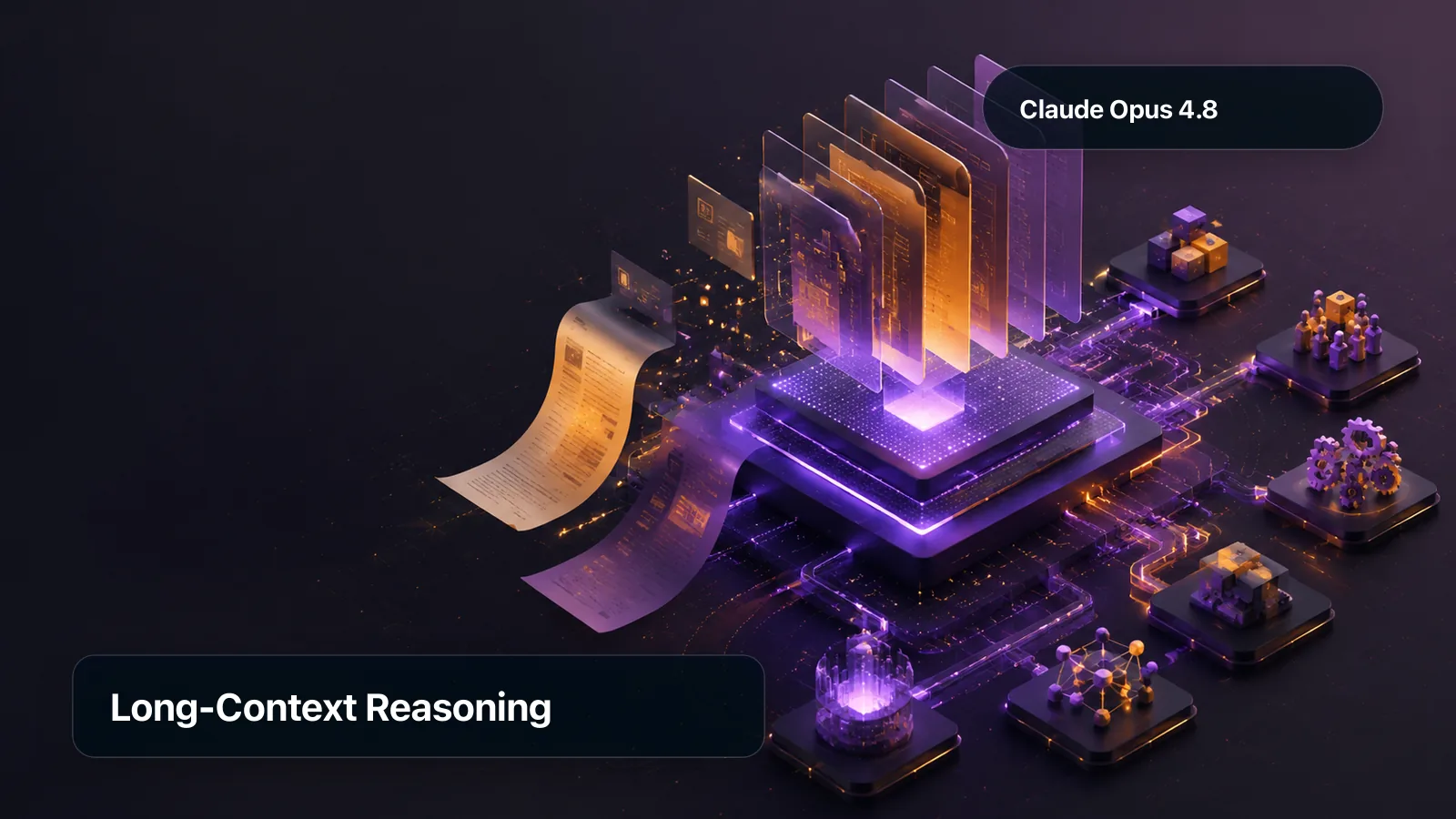
Long-context processing

Use a large context window for codebases, documents, conversation history, and multi-step instructions while monitoring token cost.

/04

Tool and agent workflows

Let Claude Opus 4.8 prepare or select tool calls while your application enforces permissions, validates arguments, and records actions.

Integration

How to integrate the Claude Opus 4.8 API

Integrating the Claude Opus 4.8 API is a three-step path from playground test to authenticated production request. The page keeps the model identifier, request schema, pricing, and response examples together. Move from a representative prompt to monitored production traffic with explicit quality and fallback checks.

Claude Opus 4.8 API integration from request to output
Connecting Claude Opus 4.8 from API request to result.
  1. 01

    Create an API key

    Sign in to APIAny, create a project API key, and assign only the model scope and budget controls your application needs.

  2. 02

    Send a Claude Opus 4.8 request

    Copy the request example from this page, set the model field to the selected Claude Opus 4.8 version, and send it to the documented APIAny endpoint.

  3. 03

    Monitor and refine

    Track status, latency, credits, and returned usage. Compare versions or related models with the same workload before shifting production traffic.

SourceAnthropic official documentation

ProviderAnthropic

Reviewed2026-09-01

FAQ

Claude Opus 4.8 API frequently asked questions

Direct answers about capabilities, use cases, integration, and choosing the right Claude Opus 4.8 route.

What is the Claude Opus 4.8 API?

Anthropic Claude Opus 4.8 is a frontier model for demanding reasoning, large codebases, long-form analysis, and complex agent workflows. APIAny makes this model callable through an authenticated API with live pricing, status information, request examples, and a browser playground on the same page.

What can I build with the Claude Opus 4.8 API?

Common Claude Opus 4.8 workflows include Coding agents and software delivery, Long-document analysis, Research and complex reasoning. The best fit depends on the input format, output quality, latency, and cost your product requires.

How do I call Claude Opus 4.8 through APIAny?

Create an APIAny key, use the endpoint documented on this page, and set the request model field to the selected Claude Opus 4.8 version. The playground can generate a working payload before you integrate it into application code.

New users get free credits - no credit card required Get started
APIAny logoAPIAny
AI Models
PricingFree API
Resources
Sign InGet Started

APIAny API gateway for every production AI model.

Popular Models

Collections

Model Types

Platform

  • Docs
  • Contact

Legal

Claude Opus 4.8 API example for Long-document analysis
Long-document analysis with Claude Opus 4.8.

03

Research and complex reasoning

Use Claude Opus 4.8 to decompose difficult questions, compare evidence, and produce decision-ready analysis. Ask the model to distinguish sourced facts, assumptions, and recommendations so reviewers can verify the result.

Try Claude Opus 4.8 in the playground

Claude Opus 4.8 API example for Research and complex reasoning
Research and complex reasoning with Claude Opus 4.8.

Production routing controls

Use model status, channel health, retry policy, and usage logs to operate Claude Opus 4.8 as part of a production workflow instead of treating it as an isolated demo.

/05

Streaming responses

Render supported Claude Opus 4.8 text output incrementally for interactive assistants and long-running generation tasks.

How should I choose a Claude Opus 4.8 version?

Compare the versions shown on this page by price, supported parameters, and capabilities such as Complex reasoning, Code generation and analysis, Long-context processing. Test a representative production input before choosing the default route.

APIAny logoAPIAny© 2026 APIAny. All rights reserved.
support@apiany.ai
Seedance 2.0
GPT Image 2
Nano Banana 2
Z-Image
Gemini Omni
All Collections
GPT API Family
Seedance API Family
Gemini API Family
GPT Image API
Text Generation
Image Generation
Video Generation
Audio Generation
Models
Pricing
About
Privacy Policy
Terms of Service
Refund Policy
English
Français
Deutsch
中文
日本語
한국어
Español